If that headline made you do a double take, you’re not alone. The idea of a TVS iQube delivering 545 km on a single charge, juicing up in an hour, and landing in your garage for ₹55,000 sounds irresistible—but it doesn’t reflect the scooter’s official specifications, real-world performance, or market pricing. The current iQube lineup tops out at a certified 212 km (IDC) range on the ST 5.3 kWh variant, with home charging designed around a portable charger that takes hours, not one hour, to replenish. Pricing for 2025 models begins in the six-figure ex-showroom band depending on the variant and city. That means the “bumper offer” and extreme claims should be treated as viral buzz or promotional spin, not a basis for purchase decisions.
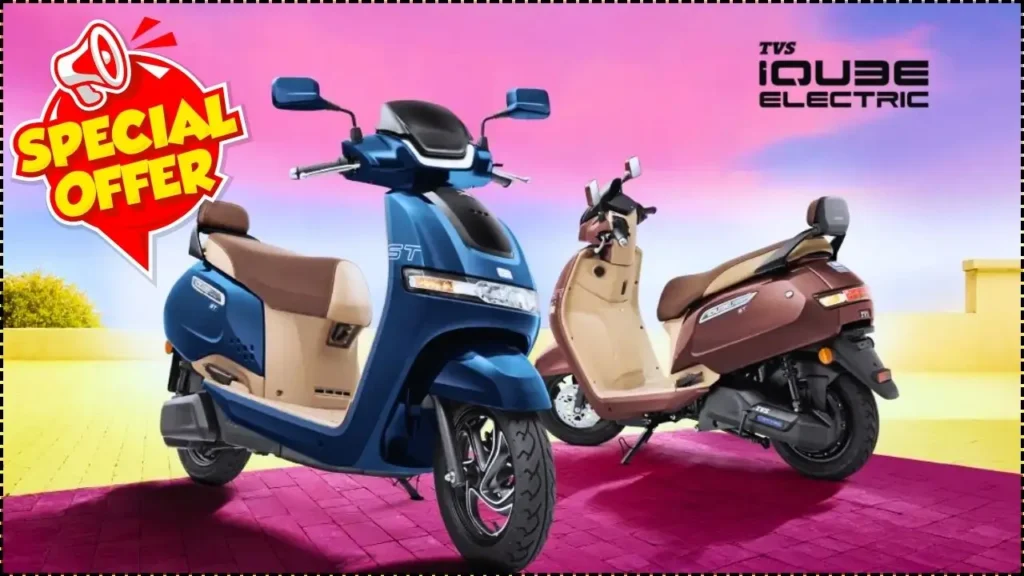
The scooter’s publicly listed specs point to a practical city commuter built for reliability, connected features, and home charging convenience not a 545 km touring machine with ultra-fast charge. If you’re cross-checking for clarity, the iQube family spans multiple batteries: an entry pack intended for short urban runs, mid-tier options for extra cushion, and the flagship ST 5.3 kWh variant with the longest certified range. Charge times vary by battery and charger output; the portable-charger experience is designed for overnight or daytime top-ups rather than rapid DC-style refills. Pricewise, even with incentives, you should expect modern EV-scooter numbers, not a sub-₹60,000 doorbuster.
Table of Contents
TVS iQube Electric Scooter
| Item | Details |
|---|---|
| Official top IDC range | Up to 212 km on the iQube ST 5.3 kWh |
| Typical 0–80% charging | Several hours with the portable charger (variant-dependent) |
| Battery options | Entry-level, mid-tier (around 3+ kWh), and ST 5.3 kWh |
| 2025 price pointers (ex-showroom) | Typically starts in six-figure range; higher for ST |
| Top speed (varies by variant) | Around 75–82 km/h |
| Charging method | Standard home socket via portable charger |
| Connected features | Turn-by-turn navigation, app connectivity, OTA where applicable |
| Use case | Urban and suburban daily commuting |
Chase the right promise, not the flashy headline. The TVS iQube isn’t a 545 km, 1-hour-charge, ₹55,000 miracle scooter; it’s a thoughtfully built urban EV with verified range, portable home charging, and variants that map cleanly to real Indian riding patterns. If you calibrate expectations around IDC versus real-world range, understand that portable charging is a slow-and-steady convenience, and lock down an on-road price from an authorized dealer, you’ll end up with a scooter that does exactly what you need: a quiet, low-hassle, cost-efficient partner for everyday mobility.
What’s Actually New For 2025
The iQube family saw meaningful updates that focus on usable range, connected tech, and practicality. The standout remains the long-range ST variant with its certified 212 km IDC figure, giving city riders enough buffer for multi-day commuting with conservative riding. Mid-tier variants (commonly in the 3–3.5 kWh class) strike a smart balance between price and range, ideal for those who want fewer charging sessions without jumping to the flagship. Entry variants suit short-hop users who value lighter weight and quicker top-ups from low states of charge. The theme across the lineup is consistency and convenience: ease of ownership, home charging, and reliable day-to-day range.
Range And Charging Realities
There are two important realities to internalize. First, IDC range is a standardized lab metric; it’s useful for apples-to-apples comparisons but sits above real-world mixed riding outcomes. In practice, traffic, speed, gradients, rider weight, and temperature all nudge real range downward. Second, portable chargers prioritize convenience and battery longevity over brute speed. This is why 0–80% typically takes hours, not a single hour; it’s a design choice that supports daily use without specialized infrastructure. If your routine involves 30–50 km per day, an overnight top-up keeps things predictable. If you hit longer routes, plan for charging windows rather than expecting DC fast-charging behavior.
Variants And Who They Suit
- Entry Battery (around 2.2 kWh): Best for short, dense urban commutes, delivery loops, and predictable routines with easy access to home or office sockets. Lighter feel, nippy response, and quicker 0–80% replenishment from low SOC make it hassle-free for city cores.
- Mid Battery (around 3.1–3.5 kWh): The sweet spot for most buyers. Expect a notable bump in IDC range, more headroom for suburb-to-city runs, and fewer charging stops through the week. If you’re toggling between Eco and Power modes with occasional ring-road sprints, this class feels just right.
- ST 5.3 kWh: The range leader with the 212 km IDC claim, built to minimize range anxiety if your daily graph fluctuates. This is the pick for riders stacking multiple trips, occasional weekend errands across town, or simply wanting the longest buffer without micromanaging the throttle.
TVS iQube Electric Scooter Pricing, Subsidies, And The ₹55,000 Headline
The 2025 sticker story for iQube sits well north of ₹55,000. Even with central and state EV incentives, the ex-showroom prices for mainstream variants start high enough that a sub-₹60,000 outlay would typically signal either a booking figure rather than full ownership cost, an aggressively marketed local scheme with caveats, or a mismatch between the claim and the actual variant. Always itemize the deal: ex-showroom price, insurance, registration, handling, charger cost (if billed separately), and any accessory packs. Confirm state subsidy eligibility and timelines. Ask for a full on-road quote in writing and compare across two authorized dealers in your city to avoid surprises.
Features That Matter Every Day
The iQube lineup emphasizes the stuff riders use daily. Expect a connected cluster with navigation, call/SMS alerts, remote charge status, distance-to-empty, trip metrics, and over-the-air update capability depending on variant. Ergonomics are family-friendly, with storage that comfortably swallows a daily carry. Top speeds around 75–82 km/h fit metro expressways and ring roads while preserving battery efficiency. Braking and suspension setups are tuned for Indian roads—predictable, forgiving, and confidence-inspiring across monsoon patches and patchwork tarmac. The result is a commuter EV that fades into your routine rather than demanding special planning.
Buying Advice
- Informational intent: If you’re simply learning, focus on variant differences (battery size, display, features), IDC vs real-world expectations, and charging time realities. IDC is a benchmark; your real range depends on context.
- Transactional intent: If you plan to book soon, shortlist two variants based on your daily km. Most urban riders are happiest in the 3–3.5 kWh class; long-city runners and range-maximizers gravitate to ST 5.3 kWh. Request on-road quotes, lock in test rides, and ask about charger inclusion and delivery timelines.
- Navigational intent: If you’re locating official details, head to the manufacturer’s model, variant, and pricing pages. Cross-check a trusted auto portal for a quick side-by-side. Verify your city availability and color options, since dispatches can be staggered.
Is Claim Real?
TVS iQube Electric Scooter with 545 KM Range & 1-Hour Fast Charge: Bumper Offer at ₹55,000—continues to trend, likely because it’s so clickable. But it’s not representative of the manufacturer’s published range and charging profile, nor the market pricing for 2025 variants. Treat it as a cautionary tale about vetting EV claims: long range and super-fast charging often require large battery capacities, high-voltage architectures, and specialized chargers. Scooters tuned for urban India, with portable home charging and robust aftersales, are built around a different philosophy: reliability, convenience, and total cost of ownership.
How To Evaluate Big EV Claims
- Check the variant name and battery capacity. A “range” claim without battery context isn’t useful.
- Look for clarity on the test cycle (IDC vs real world) and charger type/output. One-hour claims often imply specialized infrastructure.
- Confirm whether the quoted price is booking, ex-showroom, or on-road. Ask for a detailed cost sheet.
- Scan warranty terms for the battery and the availability of service centers in your city.
- Weigh your real daily use. If you ride 35–60 km a day, a mid-pack battery with overnight charging is often the quiet hero.
Who Should Buy The iQube
If your routine prioritizes predictability, low running costs, and a mature service network, the iQube family fits neatly. Entry variants make sense for compact-city riders who value low-cost ownership and quick top-ups. The 3–3.5 kWh class delivers that reassuring middle ground: fewer plugs per week, flexible weekend runs, and strong feature sets. The ST 5.3 kWh variant is the premium solution for those who want a long buffer, minimal charge anxiety, and richer tech. Across the spectrum, you’re buying into an ecosystem that centers on daily ease, not record-setting specs.
FAQs on TVS iQube Electric Scooter
What Is the Real Range of the TVS iQube ST?
Expect the certified up to 212 km IDC to trend lower in mixed riding. With careful throttle, urban speeds, and favorable conditions, you’ll come closer; with higher speeds and heavier loads, expect less.
Does The TVS iQube Support 1-Hour Fast Charging?
The iQube’s home-charging setup with a portable charger is designed for several hours to replenish, not one hour. Plan for overnight or daytime top-ups, which pairs naturally with city commuting.
What Are The 2025 Prices For iQube S And ST?
Ex-showroom prices for 2025 commonly start in the six-figure range for S variants and extend higher for the ST 5.3 kWh. Final on-road prices depend on city, insurance, and accessories.
Which iQube Variant Is Best for City Commuting?
For most riders, a mid-battery around 3–3.5 kWh balances price and range for 40–70 km daily patterns. Choose the ST 5.3 kWh if you want the highest buffer and fewer charging sessions through the week; pick the entry pack for short, predictable city loops.