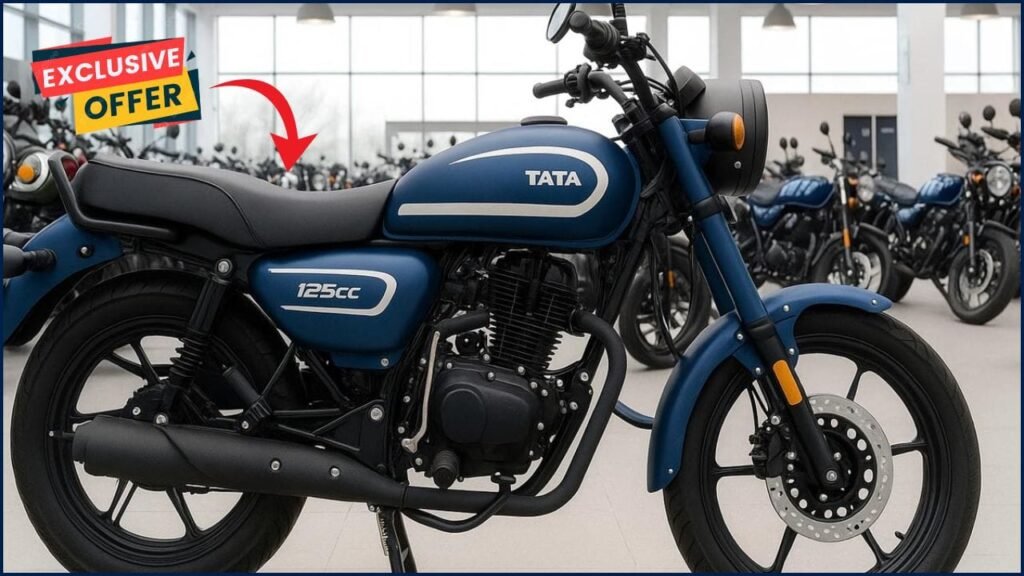
Tata Motors, renowned for its innovation in the automotive sector, has entered the Indian two-wheeler market with the launch of a new 125cc bike. Priced at a highly competitive ₹55,999, this motorcycle is designed to offer an impressive fuel efficiency of 85 kilometers per liter. Positioned as an affordable, reliable, and fuel-efficient option, it directly targets the growing segment of budget-conscious commuters. This move is set to challenge established players in the 125cc category like Hero MotoCorp and Bajaj Auto.
Table of Contents
Tata’s Strategic Foray into the Two-Wheeler Market
Tata Motors’ decision to launch a motorcycle marks an ambitious shift for the company, which has traditionally focused on four-wheel vehicles. While Tata has previously explored electric two-wheelers with their Tata Tigor EV concept, their new 125cc bike is their first foray into the mass-market two-wheeler segment. It comes as no surprise that the company is expanding its footprint, considering the significant demand for affordable and fuel-efficient transportation in India.
India’s Growing Demand for Affordable Two-Wheelers
India is the world’s largest market for two-wheelers, with over 20 million units sold annually. In recent years, the increasing price of fuel has driven demand for motorcycles and scooters that offer high fuel efficiency at lower prices. According to data from the Society of Indian Automobile Manufacturers (SIAM), motorcycles in the 125cc category are particularly popular in urban areas, where cost-conscious consumers need reliable vehicles for daily commutes.
Tata’s entry into this market highlights the company’s strategic vision to meet the evolving needs of India’s rapidly growing middle class, who are increasingly looking for affordable transportation options that don’t compromise on performance or fuel economy.
Key Features of the Tata 125cc Bike
The new Tata 125cc motorcycle promises a combination of affordability, high mileage, and practicality. While complete specifications are still awaited, several key features have already been confirmed.
Fuel Efficiency and Engine Performance
The fuel efficiency of 85 kilometers per liter is a significant highlight of the Tata 125cc bike, setting it apart from competitors in the same category. This level of mileage is expected to appeal to daily commuters, especially in cities like Delhi, Mumbai, and Bangalore, where fuel costs are a growing concern. For comparison, popular models such as the Honda CB Shine offer a mileage of around 65 km/l.
This efficiency is driven by Tata’s integration of modern fuel injection technology into the bike’s design, which enhances engine combustion and reduces fuel consumption. Additionally, the engine is expected to be a single-cylinder, air-cooled unit, designed for ease of maintenance and reliability.
Comfort and Design
The bike’s design is tailored for both urban and long-distance riders, with a focus on comfort and functionality. Early renderings suggest a sleek, lightweight frame with an ergonomic design, including a well-padded seat and a comfortable riding posture. The high ground clearance and robust suspension system are expected to ensure a smooth ride, even on rough city roads.
The bike is also expected to feature a digital instrument console, which provides riders with a modern, easy-to-read interface. Features such as a digital speedometer, trip meter, fuel gauge, and battery indicator will enhance the overall riding experience, making it more user-friendly for tech-savvy riders.
Tata Motors’ Competitive Pricing and Market Impact
At a price of ₹55,999, the Tata 125cc bike offers a compelling value proposition in a segment dominated by established players. The price point places it below other popular models in the same category, such as the Bajaj Pulsar 125 (₹72,000) and the Honda CB Shine (₹74,000), making it a highly attractive choice for price-sensitive consumers.
Tata’s Pricing Strategy: Aiming for Mass Market Appeal
The affordable pricing strategy is intended to make the Tata 125cc bike an accessible option for the average Indian consumer, particularly first-time bike buyers. By offering best-in-class mileage at an attractive price, Tata is positioning the bike to appeal to daily commuters, college students, and young professionals seeking a reliable, cost-effective solution for their transportation needs.
Analysts believe Tata’s competitive pricing strategy will disrupt the current market landscape, forcing competitors to reevaluate their offerings in this category. In an industry where price sensitivity is paramount, Tata’s approach could prove to be a winning formula.
Tata Motors’ Two-Wheeler Competitors in India
While Tata’s entry into the two-wheeler market is a significant development, it faces stiff competition from both domestic and international brands. Hero MotoCorp, the largest two-wheeler manufacturer in India, has a stronghold in the 125cc segment with models like the Hero Glamour and Hero Super Splendor. Similarly, Bajaj Auto has its popular Pulsar 125 and Platina 110 models, which also cater to the same commuter segment.
Understanding Tata’s Competitive Advantage
Despite the competition, Tata Motors has a strong brand presence in India, known for its emphasis on durability and reliability. The company’s long-standing reputation for manufacturing high-quality vehicles, including cars, trucks, and electric vehicles, could give it a competitive edge in this new market.
Tata’s success in the affordable electric car market with the Tata Nexon EV also points to its ability to appeal to cost-conscious consumers looking for green alternatives. The Tata 125cc bike could potentially leverage similar attributes to appeal to eco-conscious buyers, given its high fuel efficiency.
The Environmental and Economic Impact of Fuel-Efficient Motorcycles
In addition to offering affordability, the Tata 125cc bike also aligns with India’s growing focus on sustainability. With rising fuel costs and increasing air pollution in urban centers, consumers are becoming more conscious of the environmental impact of their transportation choices. A fuel-efficient motorcycle helps reduce fuel consumption and carbon emissions, making it a more sustainable option compared to conventional cars or scooters.
Government Incentives for Green Vehicles
The Indian government has also implemented various schemes to encourage the adoption of environmentally friendly vehicles. These include subsidies and incentives for fuel-efficient two-wheelers under initiatives such as the FAME II (Faster Adoption and Manufacturing of Hybrid and Electric Vehicles) scheme. While the Tata 125cc bike is not an electric model, its impressive fuel efficiency places it in line with these green initiatives.
Expert Analysis: The Future of Tata’s Two-Wheeler Venture
Tata’s two-wheeler venture is still in its early stages, and experts remain divided on its long-term prospects. Dr. Ramesh Kumar, an automotive industry expert at the Indian Institute of Technology (IIT), suggests that the success of Tata’s new bike will depend on the company’s ability to maintain consistent quality and establish a robust service and support network.
“The two-wheeler market in India is not just about price,” said Dr. Kumar. “After-sales service, availability of spare parts, and the brand’s reputation play a crucial role in customer satisfaction. Tata Motors must ensure it provides a seamless experience from purchase to service.”
Honda Activa 8G with 125CC Engine and 65KMPL Mileage Available at ₹52,000- Dhamaka Deals
Conclusion
Tata Motors’ new 125cc bike is an exciting addition to India’s competitive two-wheeler market. With its impressive fuel efficiency, affordable pricing, and modern design, it is poised to attract a wide range of buyers looking for reliable and eco-friendly transportation. While Tata faces stiff competition from established manufacturers, the company’s reputation for quality and its customer-centric approach could position the bike as a market leader in the coming years.