Few cars in history have blended simplicity and innovation in the way the Citroën 2CV Sahara has. At first glance, it appears to be a modest, lightweight French classic — a small car built mainly for rural life, basic commuting, and general utility. But underneath its unassuming skin lies one of the most fascinating pieces of mechanical engineering of the 20th century. The Sahara, with its dual-engine configuration and rugged personality, was a vehicle created for a purpose: to conquer remote terrain where breakdowns could be life-threatening, and where reliability mattered more than power or prestige.
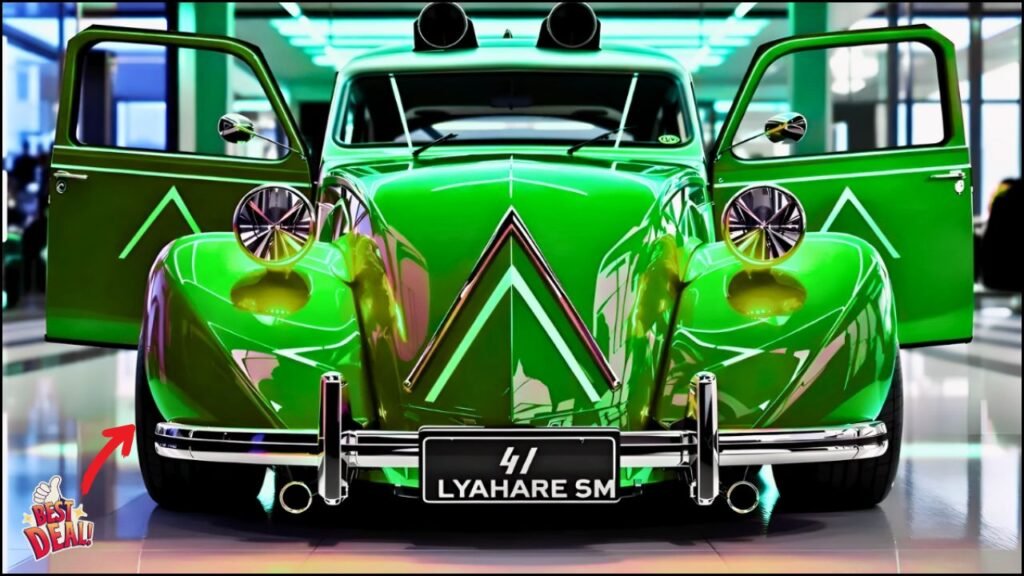
Today, the Citroën 2CV Sahara has resurfaced in automotive news thanks to surprising new discount offers that have sparked fresh interest among collectors and vintage-car enthusiasts. The reappearance of this unusual machine invites us once again to appreciate its design, purpose, and lasting influence.
Table of Contents
Citroën 2CV Sahara
The Citroën 2CV Sahara stands apart because it wasn’t simply a modified version of the regular 2CV — it was a complete re-engineering exercise centered around dependability and off-road capability. Designed in the late 1950s for regions lacking proper roads or repair facilities, it famously used two engines, with one powering the front wheels and the other driving the rear. Each had its own fuel system, ignition, and controls, meaning the driver could run them together or independently depending on the situation.
This unique configuration gave the Sahara true four-wheel drive without using a traditional transfer case or differential system. It was one of the cleverest solutions of its time. The car’s lightweight build, tall suspension, and wide-opening body panels made it ideal for desert trails, rocky paths, and rural landscapes that would challenge heavier machines.
For a long time, the Sahara was a rare curiosity — only 694 units were ever built. Now, with renewed interest and new market offers, it is reclaiming its rightful place as one of the most innovative vehicles ever made.
Overview Table of Citroën 2CV Sahara
| Feature | Details |
|---|---|
| Purpose | Designed for remote, rugged regions with minimal infrastructure |
| Dual-engine layout | Two independent engines, one front + one rear |
| Drivetrain | True 4WD without transfer case or complex electronics |
| Suspension | Raised, reinforced components for rough terrain |
| Tyres & wheels | Larger off-road wheels; spare wheel mounted on bonnet |
| Interior | Utilitarian, simple, easily repairable design |
| Off-road ability | Exceptional traction and stability in sand, gravel, mud |
| Production numbers | Approx. 694 units total, making it rare and collectible |
| Fuel system | Two separate fuel tanks and independent ignitions |
| Notable advantage | Even if one engine failed, the car could still be driven |
A Design Philosophy Driven by Necessity
While most off-road vehicles chase power, the 2CV Sahara approached the challenge from the opposite direction. Citroën engineers believed that low weight, smart engineering, and mechanical redundancy were more valuable in isolated environments than horsepower. The result was a car that floated over sand instead of sinking into it.
The decision to retain the classic 2CV body was deliberate: it kept the vehicle familiar, easy to repair, and economical to produce. Yet everything underneath was strengthened, widened, or re-purposed for durability. The hallmark spare wheel mounted on the bonnet wasn’t just a stylistic choice; it made room under the boot floor for the second engine. Every modification had purpose.
Interior: Functional, Honest, and Built for Hard Use
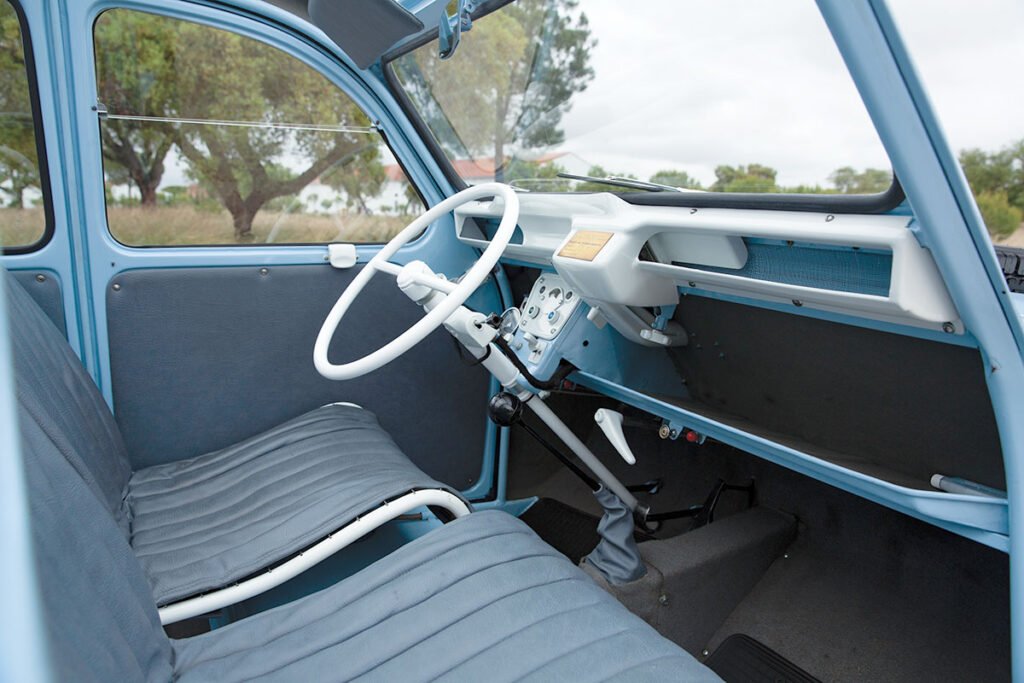
No luxury hides inside the 2CV Sahara — and that’s exactly the point. The seats are light but sturdy, and the open, airy cabin ensures visibility in all directions. Ventilation flaps, simple mechanical switches, and easily removable panels were chosen to handle extreme conditions.
The cabin’s charm lies in its minimalism. There’s a clear confidence in the idea that nothing should be included unless absolutely necessary. Even today, this no-nonsense approach feels refreshing.
Off-Road Performance That Surprised the World
Most people underestimate the 2CV Sahara until they see it in action. Its two engines create a balanced, predictable four-wheel-drive system that works beautifully on loose surfaces. The car’s low weight means it can glide over areas where large 4x4s bog down.
One of the most remarkable features is the Sahara’s ability to keep moving even on one engine. If the front engine fails, the rear can still propel the car. In remote deserts, mountains, or jungle paths, that redundancy saved lives. Its capability turned it into a favourite of surveyors, engineers, and government agencies.
A Deeply Smart Engineering Approach
Instead of complexity, the Sahara offered clever solutions. Each engine had its own clutch, which the driver operated with a single pedal connected to both systems. Two ignition keys sat on the dashboard — one for each powerplant. The brake system, suspension, and chassis all received reinforcements.
Despite the uniqueness of its design, the Sahara remained surprisingly easy to maintain. A basic toolkit, some mechanical know-how, and a few spare parts could keep it running in harsh conditions.
Efficiency in Unexpected Places
While the idea of two engines hints at heavy fuel consumption, each engine was small and economical. Because the Sahara often required less power due to its lightweight nature, fuel usage remained manageable. In many situations, using only one engine was possible, particularly on smoother terrain. For remote work, that flexibility was essential.
Heritage and Historical Impact
The Sahara was more than a vehicle — it represented a philosophy of mobility that contrasted sharply with Western trends toward larger, more powerful cars. It symbolised the idea that you could achieve extraordinary capability through simplicity.
Its legacy influenced lightweight off-road vehicles in Europe and Africa, and today it remains one of the most respected examples of minimalist engineering accomplishing maximum results.
The Sahara in Today’s Classic Car Market
Collectors love originality and rarity — and the Citroën 2CV Sahara has both in abundance. Prices for authentic models have climbed steadily, making the recent discount offers particularly attention-grabbing. Interested buyers should be cautious, verifying documentation, engine serial numbers, and restoration details, as genuine Sahara units are extremely rare.
How the Sahara Compares to Other Off-Road Icons
To put its uniqueness into perspective:
Vs. Land Rover Series I or II
Land Rovers offered more power but were heavier, sometimes sinking into soft ground the Sahara could skim over.
Vs. Jeep CJ Models
The CJ had stronger engines and military toughness, but lacked the Sahara’s mechanical redundancy and lightweight advantage.
Vs. Volkswagen Beetle Baja-style
Both used simplicity as a strength, but the Sahara’s dual-engine system gave it better off-road consistency.
These comparisons show the Sahara’s real secret: capability through clever design rather than brute force.
Modern-Day Relevance
In a world where cars grow increasingly complex with electronics, sensors, and software, the Sahara reminds us of an era when durability came from mechanical ingenuity. Enthusiasts appreciate that it offers an off-road experience that is pure and unfiltered — no traction control, no digital aids, just engineering and driver skill.
Its modern relevance also lies in sustainability. A small, efficient vehicle that can traverse challenging terrain with minimal fuel is a lesson still valuable today.
Buying Guide and Ownership Experience
For those considering owning a Sahara today, here are key points:
What to Look For
- Matching engine numbers
- Original reinforced chassis
- Bonnet-mounted spare wheel (authentic location)
- Proper twin-gearbox configuration
- Documented history confirming authenticity
- Rust-free structural elements
Maintenance Experience
The beauty of the Sahara is that most repairs can be done with basic tools. Owners often describe it as “a car that teaches you as you drive it.” Running two engines does require extra attention, but the simplicity of each unit makes maintenance surprisingly manageable.
Toyota’s 2025 SUV with Stylish Design & Smart Features- Massive Dhamaka Offer!
Driving Impressions Today
Driving a Sahara is charming, slow, and mechanical in the best possible way. It encourages a relaxed pace, inviting the driver to enjoy scenery rather than rush past it. On loose terrain, the car feels confident and nimble, proving its original purpose remains valid decades later.
Conclusion
The Citroën 2CV Sahara proves that brilliance does not always have to shout. Through clever engineering, purposeful design, and an unshakeable commitment to reliability, it became one of the most extraordinary off-road vehicles ever created.
Now, with new discount offers adding fresh attention to this historic model, a new generation of enthusiasts has the chance to rediscover its magic. For collectors, historians, and anyone who admires ingenious mechanical solutions, the Sahara is not just a car — it is a reminder of how innovation can emerge from simplicity.
Its legend continues to grow, proving once again that true icons never really fade; they simply wait to be appreciated again.