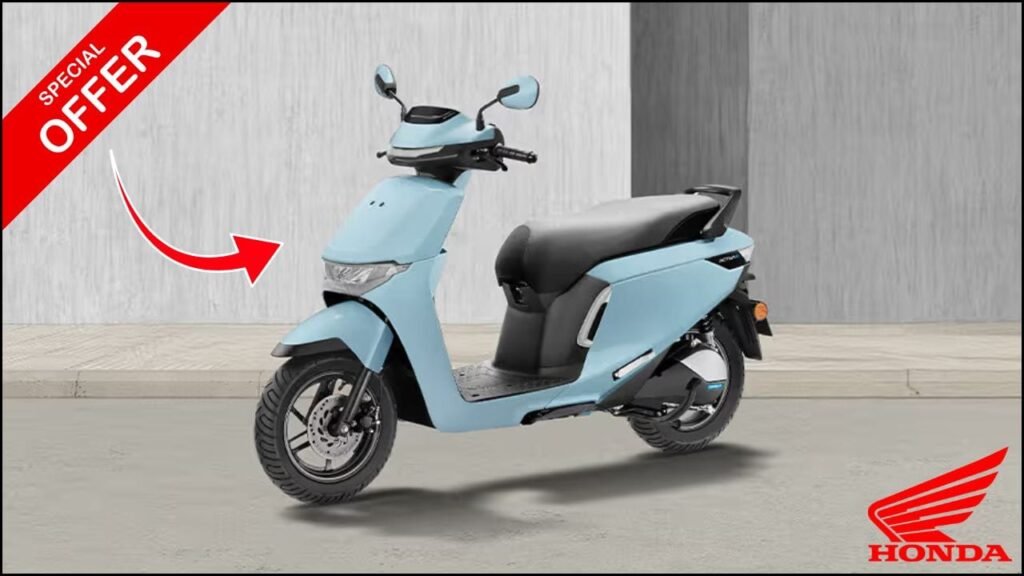
A viral social-media post claiming that the Honda Activa Electric Scooty offers a 485-kilometre range and fast-charging capability at a launch price of ₹68,000 has captured massive public attention. However, Honda Motorcycle & Scooter India (HMSI) has issued no confirmation, and experts say the figures are implausible given current battery technology.
Table of Contents
Honda’s Official Position
Honda confirmed plans to release its first electric scooter, the Activa E, as part of its new electric-mobility strategy. The official range, according to company statements in 2024, is about 100–110 kilometres per charge—suitable for daily urban commutes. The expected price range is ₹1.1–1.2 lakh (ex-showroom), placing it in direct competition with models from Ola Electric, Ather Energy, and TVS Motor.
A Honda spokesperson told The Economic Times earlier this year that the Activa E “will prioritise reliability, safety, and ease of ownership rather than extreme performance metrics.” The company’s India roadmap includes building a battery-swap ecosystem and launching at least two EV models by 2026.
Origin of the Viral Claim
The unverified claim emerged in early November 2025 through several websites and WhatsApp forwards. Posts alleged that Honda had introduced a new “Activa Electric Scooty” capable of 485 km per charge with four-hour fast charging, priced at ₹68,000 as an “exclusive launch deal.”
Fact-checkers including Boom Live and Alt News later traced the claim to unofficial marketing pages that used AI-generated images and misappropriated Honda’s logos.
Industry trackers emphasise that no such product appears in Honda’s public filings, dealer briefings, or the Bharat EV database, which lists all certified electric vehicles eligible for government subsidies.
“We have found no evidence that Honda or any licensed partner has announced or registered a 485 km electric scooter,” said Anirban Mukherjee, senior automotive analyst at Counterpoint Research. “The specifications being shared online are technically inconsistent with the Activa E platform.”
Understanding the Real Model: Honda Activa E
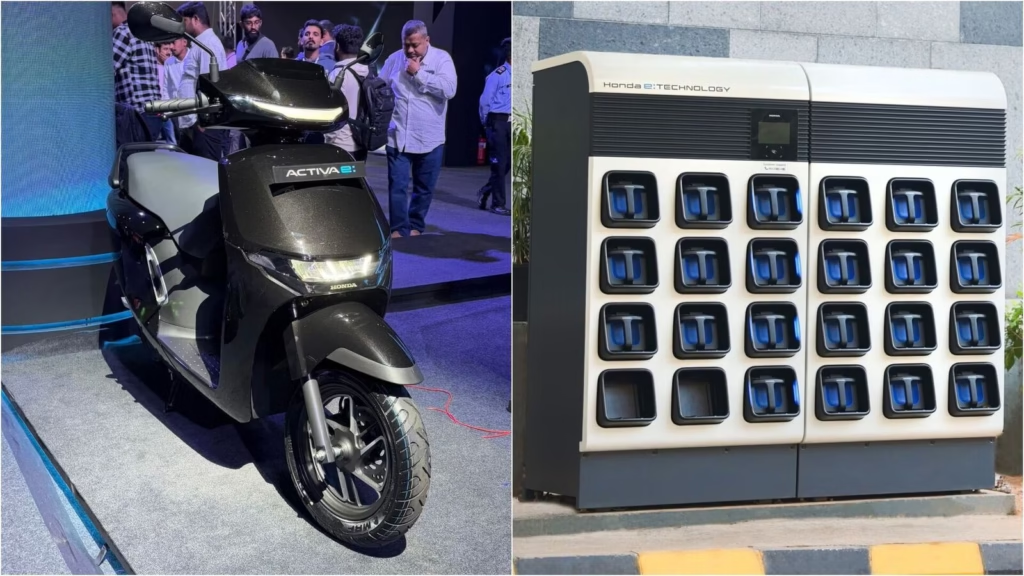
The confirmed Activa E uses Honda’s Mobile Power Pack e, a swappable lithium-ion battery system allowing users to exchange depleted batteries at designated stations. Each pack stores about 1.3 kWh of energy, enabling roughly 100 km of range.
The company plans to deploy battery-swap kiosks in collaboration with HMSI Energy India, with pilot locations in Bengaluru and Delhi before scaling nationwide.
Experts note that 485 km would require a battery of at least 6 kWh, adding over 40 kg to the scooter—far beyond its chassis limits. “Such claims violate basic energy-density math,” said Dr Kiran Deshmukh, professor of mechanical engineering at the Indian Institute of Technology Bombay. “It’s simply not feasible at this price or weight class.”
India’s Expanding EV-Two-Wheeler Market
India’s two-wheeler EV sales rose 32 percent year-on-year in FY 2024, totalling 1.58 million units, according to the Society of Manufacturers of Electric Vehicles (SMEV). Urban commuters, attracted by lower running costs and government incentives, are driving adoption.
However, rural uptake remains slow due to limited charging infrastructure and upfront costs.
Analysts expect Honda’s entry to legitimise the market segment. “When a legacy brand like Honda steps in, it signals long-term commitment and builds consumer trust,” said Meera Patel, mobility policy lead at the Centre for Science and Environment (CSE). “But misinformation can derail that trust before launch.”
Why Such Claims Spread
Digital-marketing analysts point to a mix of clickbait economics and low consumer awareness. Fraudulent websites often fabricate dramatic specifications to attract traffic and capture deposits from unsuspecting buyers.
Dr Radhika Menon, digital-policy researcher at IIT Madras, explained:
“The combination of AI-generated visuals, anonymous domain registrations, and WhatsApp virality makes such scams persuasive. Consumers must rely on verified sources like the manufacturer’s website or authorised dealerships.”
Honda has publicly advised customers to verify promotions and report suspicious links through its customer-care portal. The company also collaborates with CERT-IN (Computer Emergency Response Team India) to take down fraudulent domains impersonating its brand.
Regulatory Perspective
The Ministry of Heavy Industries (MHI) confirmed that no manufacturer has applied for certification of a 485 km scooter under the FAME-II (Faster Adoption and Manufacturing of Hybrid and Electric Vehicles) scheme.
“All vehicles sold in India under EV subsidy programmes must meet verified technical parameters,” an MHI official told Reuters India. “Any advertisement outside this list should be treated as misleading.”
The government is now considering a mandatory QR-code verification system for all EV advertisements to curb misinformation and ensure transparency for consumers.
Economic and Environmental Implications
Electric two-wheelers play a crucial role in India’s transition away from fossil fuels. The sector could reduce national fuel consumption by over 1.5 billion litres annually by 2030, according to the International Energy Agency (IEA).
But inflated claims risk distorting consumer expectations, leading to disillusionment and slower adoption.
“Hype helps early interest, but sustainability depends on credibility,” said Rohit Kapoor, senior vice-president at Ernst & Young India’s mobility practice. “People must trust that what’s promised on paper matches road reality.”
Consumer Advisory
Prospective buyers should check official listings and avoid paying online booking fees to third-party sites. Genuine Honda dealerships issue receipts with a dealer code and corporate GST number.
Honda’s verified domain is www.honda2wheelersindia.com, and all legitimate EV updates appear under its “Electric Mobility” section.
Customers can also consult the Bharat EV specification portal and Vahan.gov.in for model registration data.
The Broader Global Strategy
Globally, Honda intends to launch 10 new electric two-wheelers by 2030, aiming for 15 percent of its global scooter sales to be electric by 2027. India will serve as a primary production base and export hub for Asia-Pacific markets.
The Activa E forms part of this ecosystem, integrating smart connectivity features such as digital dashboards, navigation, and real-time battery analytics.
TVS iQube Electric Scooter Offering 410KM Range and Smart Features- Now on Bumper Sale
Conclusion
The widely shared claim of a Honda Activa Electric Scooty offering a 485 km range and ₹68,000 price tag remains unverified and technically improbable. The real Activa E, expected in 2025, offers a realistic 100 km range and aligns with Honda’s emphasis on reliability over spectacle.
As India accelerates toward electrification, credible information, responsible journalism, and digital literacy will remain key to ensuring consumers make informed choices in an evolving market.