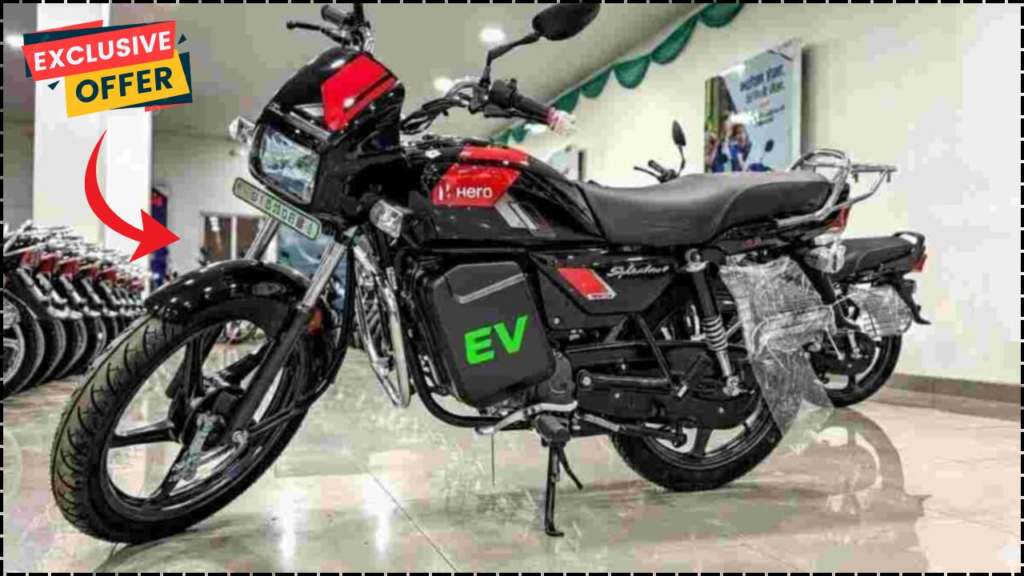
Claims that the Hero Splendor Electric—a supposed 300 kilometre-range electric version of India’s most popular commuter motorcycle—is already on sale at a steep discount have circulated widely across social media. However, no official confirmation or verifiable evidence supports these reports. While Hero MotoCorp has confirmed development of an electric motorcycle inspired by the Splendor brand, the company has not announced specifications, launch dates, or prices.
Table of Contents
The Splendor’s Legacy and Hero’s EV Ambition
A household name in Indian motorcycling
Since its first release in the early 1990s, the Hero Splendor has become synonymous with dependable, fuel-efficient commuting. For decades it has dominated the 100-125 cc motorcycle segment and earned a reputation for low maintenance and long-term durability. For many Indian households, especially in smaller towns and rural regions, “Splendor” is practically shorthand for a two-wheeler.
A slow but deliberate shift to electrification
Hero MotoCorp—the world’s largest two-wheeler manufacturer by volume—has gradually entered the electric-mobility segment. The company has launched the Vida V1 electric scooter and invested in research and development at its Centre of Innovation and Technology in Jaipur. Executives have also hinted at plans for a full-scale commuter motorcycle powered by electricity, often described in industry discussions as the “Splendor Electric.”
Hero has indicated that the electric motorcycle will be built on a new architecture rather than a direct conversion of the existing Splendor. The goal is to combine the brand’s familiarity with modern EV technology for daily riders.
The Origins of the “300 km Range” and “Price Drop” Claims
Where the rumours began
The buzz around a “300 km range” emerged from unverified online posts claiming that Hero would launch the Splendor Electric with an exceptional range and a price between ₹ 70,000 and ₹ 90,000. Some even suggested a “special introductory offer” close to ₹ 45,000. The figures spread rapidly through social-media forwards and online forums, fuelling speculation of an imminent launch.
Why the numbers don’t add up
No credible manufacturer currently sells a commuter electric motorcycle offering 300 kilometres of real-world range at that price. To achieve such distance, the vehicle would require a battery of roughly 8–10 kWh, far larger and costlier than what is feasible for a budget commuter bike. Even with government subsidies, such a model would likely exceed ₹ 1.2 lakh in price.
Automotive analysts note that range claims circulating online are probably based on theoretical estimates or early-stage prototypes, not on verified test results.
What Has Been Officially Confirmed
- Development Stage: Hero MotoCorp has acknowledged that an electric motorcycle project inspired by the Splendor is under development. Company executives have referred to 2026–2027 as the tentative target for market introduction.
- Technical Details: No official data exist on battery capacity, range, or charging time.
- Price and Availability: The company has not opened bookings or declared any official pricing.
- Dealership Information: Authorised Hero dealerships report no stock or delivery schedule for a Splendor-branded EV as of now.
In short, there is no evidence of a commercial launch or sale.
Comparing Facts and Claims
| Aspect | Verified Fact | Unverified Claim |
|---|---|---|
| Development status | Hero MotoCorp confirms an electric motorcycle is in the works. | Product already on sale across India. |
| Range | No official number released. | 300 km per charge under ₹ 1 lakh. |
| Price | Yet to be announced. | “Introductory offer” of ₹ 44,999. |
| Launch timeline | Expected mid-to-late decade (2026–2027). | Already available in dealerships. |
Understanding Electric Motorcycle Ranges
Laboratory vs real-world performance
Range figures in electric-vehicle advertising often differ sharply from on-road reality. Manufacturers usually test their vehicles under controlled conditions—moderate speeds, flat terrain, and constant temperature—to maximise results. In Indian traffic, where riders face stop-and-go movement, inclines, and heat, actual range tends to fall 20–40 percent short of laboratory claims.
What 300 km would require
A commuter electric motorcycle typically carries a 3–4 kWh lithium-ion battery. This capacity provides about 100–130 kilometres of practical range. To triple that distance, the manufacturer would need a larger battery pack, which increases weight, reduces performance, and drives up cost. Unless there is a significant technological breakthrough, a 300 km-range commuter bike under ₹ 1 lakh remains improbable in the near term.
Broader Context: India’s Electric Two-Wheeler Market
Rapid expansion and policy support
India’s electric-two-wheeler market has grown quickly in recent years, encouraged by state and central incentives such as the FAME II (Faster Adoption and Manufacturing of Electric Vehicles) scheme. Several manufacturers—Ola Electric, TVS Motor, Bajaj, Ather Energy and Revolt—have launched scooters and motorcycles targeting urban riders.
Hero’s current position
Hero MotoCorp entered the EV segment relatively late compared with some competitors. Its Vida V1 Pro scooter, launched in 2022, was aimed at premium buyers but recorded modest sales. A Splendor-branded electric motorcycle could therefore become Hero’s entry into the mass-market EV space, where its brand loyalty among commuters is exceptionally strong.
Competitive landscape
Ola’s S1 Pro, TVS iQube and Bajaj Chetak dominate electric-scooter sales, while Revolt’s RV 400 remains one of the few affordable electric motorcycles. None currently exceed 160 kilometres of practical range. A genuine 300 kilometre commuter bike would be disruptive—but such technology has yet to appear in mass production.
What a Real Launch Would Involve
If Hero MotoCorp were to introduce the Splendor Electric, it would need to go through several stages:
- Homologation and testing: Approval by the Automotive Research Association of India (ARAI) for safety and emissions (or zero-emissions) compliance.
- Public unveiling: Press conferences and digital campaigns through verified Hero channels.
- Dealer training and service preparation: EV-specific safety and maintenance protocols for technicians.
- Production ramp-up: Establishment of supply chains for battery modules, controllers and chargers.
- Pricing announcement: Inclusion of subsidies, warranty terms and financing options.
None of these stages has yet been observed publicly.
Expert Perspectives
Dr Anil Sharma, an independent automotive analyst, explains that Indian consumers often misunderstand range numbers. “Manufacturers typically quote ideal test-cycle results. A 150-kilometre claimed range might mean 100 kilometres in city use. A 300-kilometre claim, without details on test conditions, should be treated cautiously,” he says.
Ritu Menon, an energy-policy researcher, adds that the economics of battery manufacturing make ultra-low-priced, long-range bikes unlikely today. “Lithium-ion cells remain expensive. Unless the government dramatically expands incentives or new chemistry like sodium-ion becomes viable, we won’t see 300 kilometres under ₹ 1 lakh soon,” she notes.
A senior transport-ministry official, speaking on condition of anonymity, confirms that no manufacturer has submitted homologation paperwork for a 300 kilometre electric commuter motorcycle.
What Consumers Should Do
- Wait for official confirmation. Only trust announcements issued through Hero MotoCorp’s verified website or press statements.
- Avoid pre-booking through unofficial portals. Fraudulent sites occasionally exploit viral rumours to collect deposits.
- Compare ownership costs. When the model eventually launches, calculate electricity costs, battery-replacement expenses, and service intervals.
- Check infrastructure. Ensure access to charging points and after-sales support in your city or town.
- Assess warranty coverage. A reliable EV should offer at least three years or 30,000 kilometres of battery warranty.
Broader Significance for India’s EV Transition
A potential turning point
If Hero successfully electrifies its most iconic commuter motorcycle, it could normalise EV adoption in semi-urban and rural India. The Splendor brand carries unparalleled trust; a credible electric version might convince millions of conservative riders to switch from petrol.
Challenges ahead
The path to large-scale electrification is not straightforward. Challenges include battery-cell supply constraints, limited charging infrastructure outside metropolitan areas, and the need for recycling frameworks. Moreover, fluctuating global lithium prices affect overall affordability.
The global perspective
Other nations transitioning to electric mobility—such as China, Indonesia and Vietnam—have followed a similar trajectory: initial success in premium urban markets, followed by gradual penetration of affordable commuter models. India appears to be moving in the same direction.
What Would a Credible 300 km Range Look Like?
For an electric motorcycle to achieve 300 kilometres realistically, several conditions would need to align:
- A high-capacity battery (at least 8 kWh) using advanced cell chemistry.
- Lightweight materials to offset battery mass.
- Efficient motor and regenerative-braking systems.
- Improved charging network, offering fast and reliable top-ups.
At present, such specifications are more typical of premium electric touring motorcycles costing several lakhs of rupees, not entry-level commuter models.
Consumer Awareness: Avoiding Misinformation
The internet enables information to spread faster than official announcements. False “launch” claims can mislead buyers and create unnecessary market speculation. Consumers should verify details through:
- Hero MotoCorp’s official social-media handles (blue-tick verified).
- Press releases issued through credible news agencies.
- Reputable automotive publications and testing bodies.
Even well-intentioned posts shared within community groups can unintentionally amplify misinformation.
Conclusion
At present, no verified data confirm that the Hero Splendor Electric with a 300 kilometre range is on sale or even production-ready. The model is under development, and official details remain awaited. The claims of a massive price drop or nationwide availability are unsubstantiated.
Nevertheless, Hero MotoCorp’s ongoing electric-mobility strategy reflects the company’s long-term adaptation to India’s changing energy landscape. When the Splendor Electric eventually arrives—likely later this decade—it could become a milestone in making electric mobility truly mainstream. Until then, consumers are advised to remain cautious, verify all offers, and base decisions on credible information rather than viral posts.